I Was the Trailer Park Girl and Everyone Knew It
You can take the girl out of the trailer park, but you can't take the trailer park out of the girl...
At fifty-eight, I can tell you that with a little comic timing and get a laugh, including my own. The trouble with being good at telling a story is that you can get all the way to the laugh and skip right over how it felt to be the girl in it.
I was ashamed of being poor. I wish somebody had gotten hold of me early enough to ask, “Honey, which part of the family finances were you in charge of?”
I might have laughed at that, too. It would have been a kinder joke.
The odd thing is that I grew up to be a woman who moves pretty easily among people with money and influence. I enjoy good company, and I reserve the right to find a rich man boring. Where my history still gets interesting is in the privacy of my own head, when I let myself want something expensive, extravagant, or just a little above my station. Imagine having reached my age and discovering there’s still a station. Imagine the little bastard is staffed.
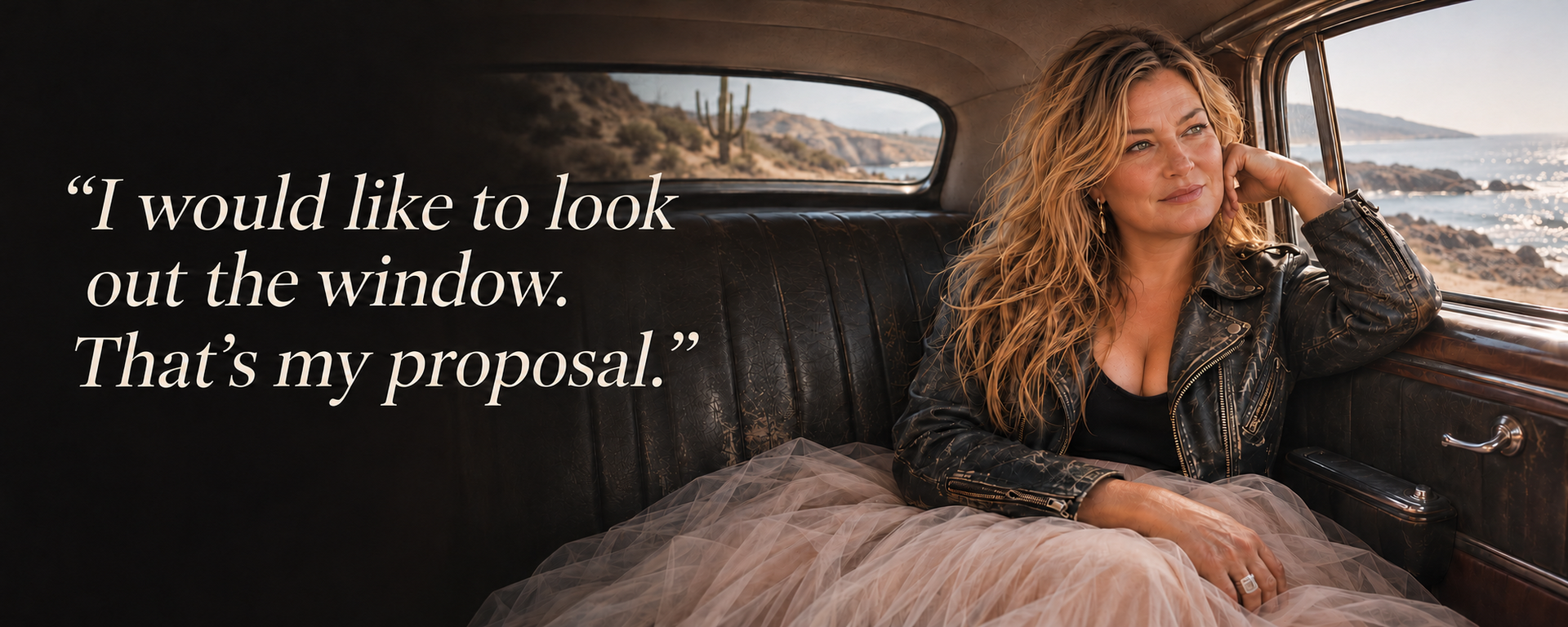
For instance, I would love to have a driver. I can feel a perfectly sensible paragraph coming on about the things I could get done in the back seat. Apparently, even in my fantasy life, a woman has to submit a productivity proposal before somebody else can drive the car.
I would like to look out the window. That’s my proposal.
This is some of the territory I mean to explore this week when I talk about identity engineering. Your life tends to organize around who you believe yourself to be. Sometimes that belief is so old, and so thoroughly reinforced by people who knew you when, that you’ve never had occasion to wonder whether you actually agree with it.
Consider the woman everyone describes as easygoing. Six people are choosing a restaurant. She has a place in mind. By the time someone asks where she’d like to eat, she’s already checked the menu in her head for her sister, considered the parking situation for her brother-in-law, and remembered that her husband had Mexican for lunch. “Anywhere is fine,” she says, quite sincerely. Then somebody picks a restaurant and asks her to call for the reservation, because she’s also the one who gets things done.
You could send that woman on a weekend retreat to discover what she wants. She knew what she wanted at six fifteen. She wanted Thai.
Identity engineering can begin right there, in the few seconds during which a woman’s preference is still available to her. She can say, “I’d love Thai tonight.” Everyone else at the table is a grown person with a mouth.
There can be a conversation. And now she gets to find out something the retreat might never have shown her. Who is she in the company of people she loves when one of them would prefer she went back to being easygoing? Who might be delighted to discover she has a favorite place and knows exactly what to order?
Poverty puts real limits on what you can buy. Patriarchy has made it costly for generations of women to be difficult to please. I take both of those things seriously. I also take seriously the years a woman can spend enforcing a rule after the people who taught it to her have forgotten her name.
Lately I’ve been playing with the idea of myself as a sovereign priestess. I like the sound of her. I like her taste. I suspect she’d have the sense to hire a driver when she could afford one. Then it occurred to me that the priestess grew up in a trailer park, and I liked her considerably more. That girl belongs in every interesting room I ever get to enter. She can sit beside me in the back seat. I bet she’d like the window, too.
If we were having dinner together and I promised to handle my own feelings about your answer, what would you let yourself say you wanted?