Beauty is Collelctive Infrastructure
Why the people who have been required to survive deserve the freedom to flourish
I want to make an argument for beauty that has absolutely nothing to do with being pretty.
I want to talk about beauty as a human necessity, particularly for people who have spent too much of their lives surviving.
I want to talk about the woman working two jobs who deserves fresh flowers on her kitchen table. The queer teenager who needs a bedroom that feels like a sanctuary. The disabled person who deserves a home designed for pleasure and ease, rather than a grudging collection of accommodations. The immigrant family that deserves a neighborhood with trees, gardens, public art, and beautiful places to gather.
I want to talk about beauty in communities that have been systematically denied resources, safety, leisure, and the simple luxury of existing without constantly anticipating the next emergency.
I want to challenge the idea that beauty is an indulgence reserved for people whose basic needs have already been met.
**People who have been required to organize their lives around survival deserve the opportunity to organize more of their lives around beauty.**
Not someday, when everything is fixed.
Now.
Survival colonizes the imagination.
When you have spent years worrying about money, safety, housing, healthcare, discrimination, or whether your family will be okay, survival has a way of occupying nearly every available corner of your attention.
You begin to evaluate everything according to its usefulness.
Will this pay the bills? Will this keep us safe? Will this get us through the week? Can I justify spending money on it? Can I justify spending time on it?
Eventually, even pleasure starts to require a defense.
A clean house is responsible. Nutritious food is necessary. Decent clothing is practical.
But a beautiful home? An extravagant meal? A dress that makes you feel extraordinary? An afternoon spent looking at art?
Those things become harder to justify when your life has been organized around meeting urgent needs.
And the conditioning can linger long after circumstances improve.
You might finally have enough money to buy the flowers and still feel guilty putting them in your cart.
For people living with persistent marginalization, the pressure can be more complicated. Financial stability does not necessarily eliminate discrimination, threats to personal safety, inaccessible environments, or the exhausting work of navigating institutions that were never designed with your well-being in mind.
There are people who have spent entire lifetimes managing circumstances that other people rarely have to consider.
They have become extraordinarily practiced at survival.
And we celebrate that survival so enthusiastically that we sometimes forget to ask what it has cost them.
I am tired of praising resilience while accepting the conditions that make so much resilience necessary.
I would like us to become equally invested in people's opportunities for delight.
Who taught us that beauty belongs to the privileged?
For generations, dominant Western beauty culture has presented a remarkably narrow picture of who deserves to be admired, adorned, celebrated, and surrounded by beautiful things.
White. Thin. Young. Able-bodied. Affluent. Conventionally feminine. Heterosexual, or at least heterosexual enough to remain comfortable for the people doing the looking.
And that picture has never been innocent.
Beauty standards have been used to enforce racial hierarchies, punish gender nonconformity, marginalize disabled bodies, and tell poor people that refinement belongs to a class they cannot enter.
Even our ideas about taste are saturated with class judgments.
One woman's elegant minimalism is another woman's empty room. A style celebrated as sophisticated in an expensive home can be dismissed as tacky when it appears in a working-class one.
We are remarkably comfortable allowing wealth and whiteness to certify what counts as beautiful.
And yet, some of the world's most extraordinary aesthetic traditions have flourished in communities denied institutional power.
The brilliance of Black hair artistry. The elaborate visual language of queer ballroom culture. The textiles, flowers, color, and ceremonial artistry of Mexican communities. Indigenous artistic traditions carrying generations of knowledge, relationship, and cultural memory.
Marginalized communities have never been waiting for someone to introduce them to beauty.
They have created, protected, and celebrated it throughout history, often in the face of extraordinary efforts to erase or appropriate their cultural expressions.
They have done so for reasons far more complex than resistance.
For pleasure. For ceremony. For love. For spirituality. For belonging. For the sheer delight of making something magnificent.
When we describe every beautiful thing created by marginalized people as an act of resistance, we risk turning their creativity into another response to oppression.
Sometimes a gorgeous dress is a gorgeous dress.
Sometimes an elaborate hairstyle is an expression of artistry, heritage, or personal taste.
Sometimes people create beautiful things because they enjoy beauty.
Their pleasure does not require a political justification.
Beauty changes the experience of being alive.
Sustained survival changes our relationship with the world.
When life feels persistently threatening, attention naturally becomes occupied with potential problems. We scan for danger, anticipate complications, and become skilled at recognizing what could go wrong.
Those skills may have kept us alive.
But they can also make the world feel like an endless series of emergencies.
Beauty offers our attention somewhere else to go.
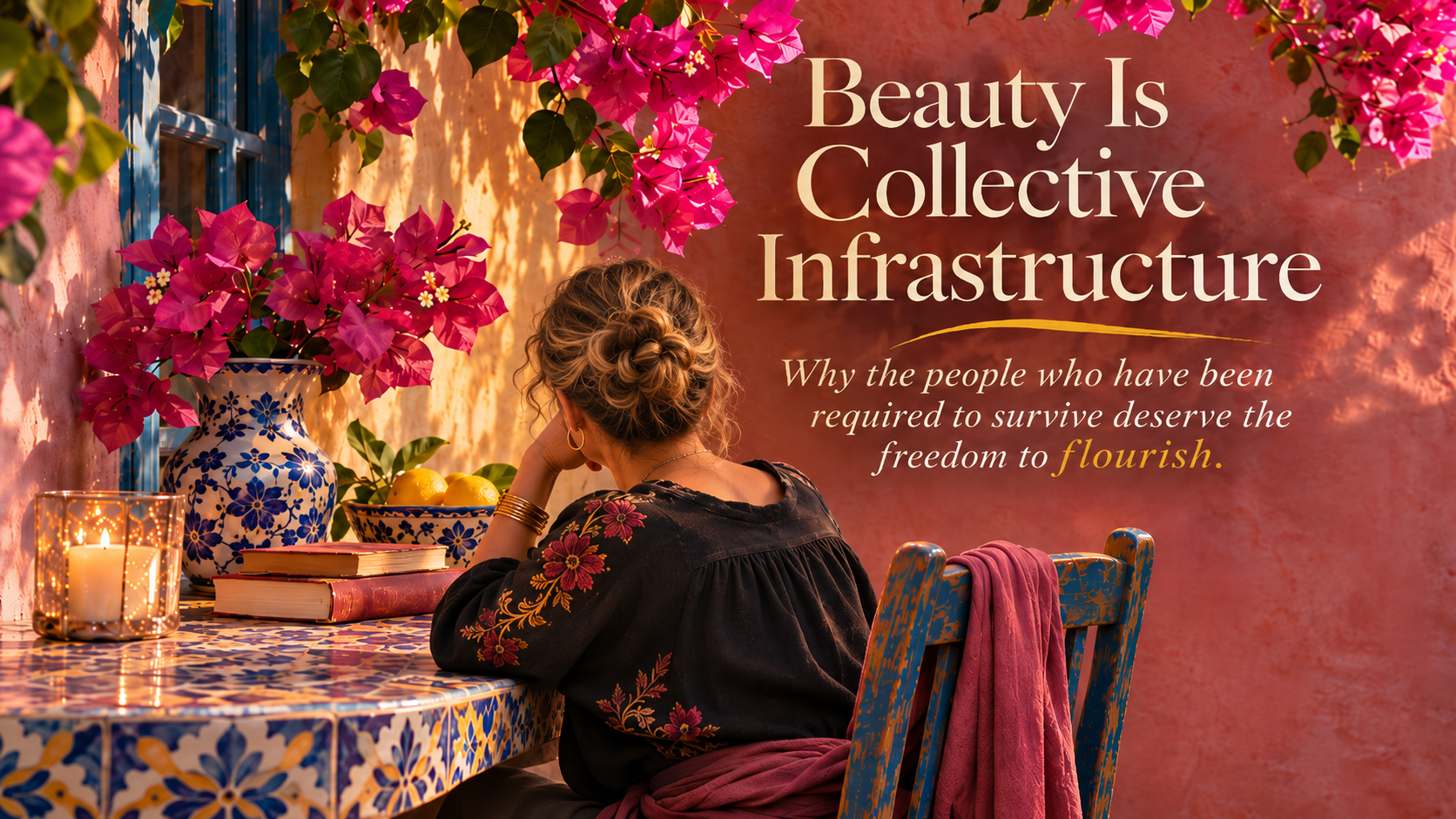
A shaft of afternoon light across a tiled floor. Jasmine coming through an open window. Music playing while someone makes dinner. The extravagant purple of bougainvillea against an old plaster wall.
For a moment, there is something worth noticing that does not require fixing.
There is pleasure available without an accompanying demand.
Research on restorative environments, contact with nature, and engagement with the arts suggests that aesthetic experiences can support psychological well-being, although their effects depend on circumstances and access.
A beautiful room cannot cure trauma. A garden cannot eliminate racism. A candle cannot make an unsafe home safe.
But beauty can change the texture of an ordinary day.
It can remind us that our senses exist for pleasure as well as vigilance, that attention can be given to wonder as readily as worry, and that there are experiences worth having simply because they are lovely.
For someone whose life has demanded prolonged endurance, that is no small thing.
Beauty is collective infrastructure.
We have spent generations treating beauty as a private luxury when it should also be understood as collective infrastructure.
A public garden is infrastructure.
A library filled with books and art is infrastructure.
A neighborhood shaded by mature trees, a plaza where families gather, a community theater, a beautifully designed accessible playground, and a cultural center preserving the artistic traditions of its people are all forms of collective infrastructure.
They shape the experience of living in a place.
They create opportunities for connection, imagination, restoration, celebration, and cultural continuity.
They communicate something about whose lives are worthy of investment.
And their absence communicates something, too.
Who gets trees on their streets?
Who gets safe parks, museums, clean beaches, beautiful architecture, and accessible cultural spaces?
Who lives next to highways, industrial waste, crumbling infrastructure, and neglected public spaces?
Who has the leisure to enjoy a beautiful afternoon, and who spends that afternoon working another shift?
These are political questions.
Access to beauty is profoundly shaped by housing policy, environmental inequality, urban planning, disability access, racial segregation, and wealth.
We cannot meaningfully talk about beauty as a universal human good while ignoring how unevenly beautiful environments are distributed.
And I have no interest in telling people living with systemic deprivation to light a candle and change their attitude.
That is spiritual bypassing dressed up in expensive linen.
I want the candle, certainly.
I also want clean water, healthcare, housing, safety, accessibility, and public investment.
I want communities to have the resources and authority to create environments that reflect their own aesthetic traditions, values, and histories.
I want art to be available to people who cannot afford museum admission. I want elders to have access to gardens and sunlight. I want disabled people to encounter beauty without navigating a series of physical barriers.
And I want us to stop assuming that functional is good enough for people living with poverty and marginalization, while beauty is reserved for neighborhoods where residents can afford to demand it.
A community should not have to become wealthy before it becomes worthy of beauty.
Beauty belongs in public budgets, urban planning, housing design, education, healthcare environments, and community development.
It belongs in our understanding of what makes a place genuinely livable.
And it belongs in the hands of the people who actually live there.
Beauty should never become another obligation.
We have a terrible habit of discovering something that can improve people's lives and immediately turning it into another responsibility.
Get enough sleep. Exercise. Meditate. Practice gratitude. Eat well. Maintain relationships. Heal your trauma. Regulate your nervous system.
Now, apparently, you must also make your life beautiful.
Absolutely not.
People who are already overwhelmed do not need another assignment.
A mother working two jobs does not need to be told that she would feel better if she arranged flowers more often.
A person experiencing homelessness does not need a lecture about cultivating an aesthetic environment.
Someone navigating disability, discrimination, or poverty does not need to be handed personal responsibility for conditions they did not create.
They need resources, structural support, safety, and choices.
And they deserve access to pleasure without having to transform it into another project of self-improvement.
There is also a danger in allowing the marketplace to define beauty for us.
The expensive furniture. The designer clothing. The perfectly renovated kitchen. The luxury vacation. The carefully curated home.
There is nothing inherently wrong with enjoying expensive things, but beauty cannot belong exclusively to people who can purchase it.
A worn table covered with a lovely cloth. Flowers cut from a garden. A carefully arranged altar. A windowsill filled with plants grown from cuttings. A meal served with such tenderness that an ordinary Tuesday becomes an occasion.
These are expressions of human imagination, attention, and care.
They are not evidence that deprivation is charming, and nobody should be expected to make poverty picturesque.
But they remind us that beauty can exist outside the marketplace.
It can be inherited, shared, grown, created, exchanged, and celebrated.
And it can be enjoyed without requiring anyone to become a better, more disciplined, more productive version of themselves.
Liberation should mean more than the absence of suffering.
I think we sometimes speak about justice as though the goal were simply to reduce suffering.
Reducing suffering is essential.
But I want us to imagine something more expansive.
What would it mean to build a world in which people had the time, resources, safety, and freedom to enjoy being alive?
Where a person could spend an afternoon reading poetry without feeling guilty about the hours they weren't productive.
Where a child could grow up surrounded by art, gardens, music, and architecture reflecting the richness of their community.
Where disabled people could participate fully in cultural and aesthetic life.
Where people could dress extravagantly, decorate according to their own tastes, celebrate their traditions, and experience sensual pleasure without having to explain themselves.
Where people who had spent generations being told to endure finally had more opportunities to flourish.
Safety is essential. Material security is essential. Civil rights, bodily autonomy, and freedom from discrimination are essential.
But I refuse to believe our aspirations for human beings should end with the absence of harm.
The purpose of liberation must include the freedom to create a life that feels wonderful to live.
And that freedom should be available to everyone.
Beauty belongs to everyone.
I want the woman working two jobs to have roses, if roses are what she loves.
I want the queer kid to have a room filled with color and possibility.
I want the exhausted caregiver to have a beautiful place to sit.
I want the disabled woman to have environments that delight her senses and welcome her body.
I want people who have spent their lives being told to be practical, grateful, quiet, invisible, and accommodating to discover their own extravagant tastes.
I want Black and brown communities to have the resources to preserve and celebrate their aesthetic traditions, and the power to determine what beauty looks like in the places they call home.
I want people who have inherited generations of survival to inherit pleasure, too.
Beauty belongs to the people who are exhausted. To the people who are grieving. To people whose bodies, identities, and histories have been treated as less worthy.
It belongs to people whose lives are complicated, precarious, and unfinished.
And it belongs to people who have already created extraordinary beauty under difficult circumstances and deserve the freedom to enjoy it without those circumstances.
**Beauty is a legitimate way of organizing a life, a community, and a society.**
It is a private pleasure, a cultural inheritance, and a collective responsibility.
And the people who have been forced to survive for far too long have an especially urgent claim to the time, resources, safety, and freedom that make beauty part of everyday life.
Because surviving is an extraordinary human accomplishment.
But it should never be the outer limit of what we imagine people deserve.
We deserve to experience the beauty of being alive, too.