Identity Drift: The Woman You Became Without Meaning To
Life beyond the borders of your circumstances
One of the strangest things about being a woman is how easily you can become very good at being somebody you never intended to be.
You can become so competent at managing a life that nobody notices you have stopped enjoying it.
You can be admired for qualities you developed under circumstances you would never willingly choose again.
And because everybody around you recognizes the woman you've become, you can start believing she is the only woman you're allowed to be.
I've been thinking about something I call **identity drift**.
It is the gradual process of becoming a person through adaptation, expectation, repetition, and reward, without ever consciously deciding that this is who you want to be.
I suspect it happens to women constantly.
You become the responsible one because your family needed somebody to be responsible. You become the easygoing one because your husband had a temper. You become the woman who can manage without much because there wasn't much to go around when you were growing up.
Perhaps you become the accomplished woman because achievement was the first thing that made people take you seriously.
Or the beautiful woman because beauty bought you a kind of social permission you couldn't get any other way.
Or the woman who takes care of everybody because being needed was the closest thing to being loved that you understood.
These identities don't necessarily begin as mistakes. Many of them are extraordinary adaptations to circumstances that demanded something of us.
Some helped us survive. Some helped us belong. Some gave us access to opportunities we might otherwise have been denied.
And some were genuinely satisfying for a while.
The problem begins when an adaptation becomes a permanent definition of who you are.
The rewards of becoming someone else
Women are trained to pay very close attention to what other people reward.
A little girl notices that people praise her for being mature for her age. She becomes the child who doesn't need much attention.
A teenager notices that having strong opinions makes people uncomfortable. She becomes wonderfully diplomatic.
A young wife discovers that her marriage runs more smoothly when she anticipates everybody's needs. She becomes the household's emotional and logistical headquarters.
A professional woman learns that being endlessly available earns her a reputation for excellence. She becomes the person who can always be counted on.
Nobody necessarily sits these women down and orders them to abandon themselves.
Often, people simply make it very pleasant to comply and very unpleasant to refuse.
A compliment here. A little disapproval there. An opportunity offered. An invitation withdrawn. A husband who is affectionate when things go his way. A boss who praises commitment but treats boundaries as a character flaw.
Over time, a woman can learn exactly which version of herself gets the best reception.
And because human beings need connection, security, and belonging, she keeps offering that version.
Eventually, she may stop noticing that she's doing it.
The problem with being good at it
There is a particular cruelty in becoming exceptionally competent at a role you no longer want to occupy.
Everybody benefits from your expertise.
Your children know you'll remember everything. Your colleagues know you'll solve the problem. Your partner knows you'll make the arrangements. Your friends know you'll understand when they cancel, forget, or need something.
You have become an institution.
And institutions are notoriously difficult to change because everybody has organized their lives around the expectation that they'll continue operating.
Sometimes the resistance is obvious. People complain, argue, or accuse you of changing.
Sometimes it is much subtler.
Your husband looks bewildered when you say you don't want to host Christmas this year.
Your adult children seem personally offended that you've decided to travel during a holiday.
Your friends laugh when you mention something ambitious or unusual because it seems so unlike you.
They aren't necessarily malicious. They may sincerely love you.
But they love a woman whose identity they believe they understand.
And now you're considering becoming somebody they haven't met.
When your life stops feeling like yours
Identity drift can be difficult to recognize because, from the outside, nothing necessarily looks wrong.
You may have a good marriage, a respectable career, a lovely home, a satisfying social life, and children you adore.
You may have achieved almost everything you once believed would make you happy.
And yet you find yourself standing in the kitchen one afternoon, looking around at a life you've spent decades constructing, feeling an almost embarrassing sense of estrangement.
You know why everything is where it is.
You remember buying the furniture. You chose the curtains. You organized the family photographs. You've made a thousand decisions about the way this life operates.
But something about it feels unfamiliar.
You can explain every individual decision and still wonder how they added up to a life that doesn't quite resemble you.
This is often the point when women begin accusing themselves of ingratitude.
They remind themselves of how fortunate they are. They catalogue their blessings. They compare their lives to women who have less.
Sometimes they decide they're depressed, bored, menopausal, selfish, or simply getting older.
Any of those things may deserve consideration. Our emotional lives are complicated, and dissatisfaction can have more than one source.
But sometimes a woman is experiencing the perfectly reasonable discomfort of realizing that she has spent years reinforcing an identity she no longer wishes to inhabit.
Her life has continued developing.
Her sense of herself has not been given the same freedom.
Who were you before everybody had an opinion?
I don't believe there is necessarily one authentic woman buried underneath all these adaptations, waiting to be excavated.
We change. We grow. We discover new desires and abandon old ones. We develop capacities we didn't have at twenty and lose interest in things we once thought were essential.
The woman you were at sixteen is not automatically more authentic than the woman you are at fifty-six.
But I do think it's worth examining how much of your current identity was deliberately chosen.
Do you actually enjoy being the person who organizes every family gathering?
Do you want the career you've become so accomplished at performing?
Are you naturally accommodating, or did you learn that disagreement carried consequences you couldn't afford?
Do you genuinely dislike attention, or did somebody once teach you that a woman who enjoys being seen is vain?
Do you prefer a simple life, or have you become skilled at convincing yourself you don't want things that once seemed inaccessible?
And perhaps most provocatively, what might you want if you weren't so committed to being consistent with the woman everybody thinks you are?
I think this is an especially interesting question for women in the second half of life.
We have decades of evidence about who we've been.
There are photographs, relationships, professional histories, reputations, family stories, and entire communities that can testify to our identities.
But evidence of who you've been is not a contract about who you must remain.
Identity can be shaped on purpose
This is where my work with identity engineering begins.
Your identity is influenced by your experiences, your environment, your relationships, the language you use about yourself, and the choices you make repeatedly.
Much of that shaping happens without deliberate participation.
Identity engineering is the practice of becoming more conscious of the process.
It begins with curiosity about the woman you have learned to be.
Which qualities do you genuinely love about yourself?
Which ones were useful once but have become restrictive?
Which expectations are you still honoring because somebody rewarded you for them thirty years ago?
Which desires have you dismissed so often that you've stopped allowing yourself to feel them?
And who might you become if your daily life began supporting a different understanding of yourself?
The work can be surprisingly ordinary.
A woman who has always described herself as shy begins accepting invitations that interest her.
A woman who believes she's terrible with money starts participating in financial decisions instead of delegating them.
A woman who has spent twenty years making dinner every evening decides that she would rather spend three of those evenings painting, swimming, dancing, or reading novels.
A woman who has built an identity around being indispensable allows somebody else to be disappointed, inconvenienced, or simply responsible for themselves.
These choices may seem small.
But they begin creating new evidence about who she is.
And over time, she has a different collection of experiences from which to understand herself.
This is how identity can begin changing intentionally, through choices that make a different way of living possible.
You do not owe anybody a permanent version of yourself
One of the great privileges of getting older should be the opportunity to become more fully ourselves.
Yet women are frequently encouraged to treat their established identities as obligations.
We're expected to remain recognizable, reliable, and reasonably predictable.
We can improve ourselves, of course. Society is delighted to sell us another program for becoming healthier, thinner, calmer, more productive, better organized, or more emotionally evolved.
But becoming radically different?
Wanting something nobody expected us to want?
Deciding we no longer enjoy a role we've performed beautifully for decades?
That can make people nervous.
I think we should become much more comfortable making people nervous.
There is no moral virtue in remaining the same woman simply because everybody has grown accustomed to her.
You can love your family and change the arrangements.
You can appreciate your career and decide you're finished with it.
You can be grateful for the life you've lived and still want something extraordinary from the years ahead.
You can recognize that a particular version of yourself was necessary, admirable, and even beloved without continuing to inhabit her forever.
And you can do all of this without presenting a convincing argument to a committee of people who preferred the previous arrangements.
I want women to have the pleasure of discovering that their identities are still alive.
That there are qualities they haven't explored, desires they haven't entertained, pleasures they haven't experienced, and versions of themselves they haven't yet imagined.
I want us to regard becoming as one of the great adventures of adulthood.
Because one day you may look around at your life and recognize how much of it was constructed by a woman who was doing her best with the circumstances, knowledge, and permission she had at the time.
You can thank her.
You can admire her ingenuity.
You can be enormously proud of everything she managed to accomplish.
And then you can begin making different decisions.
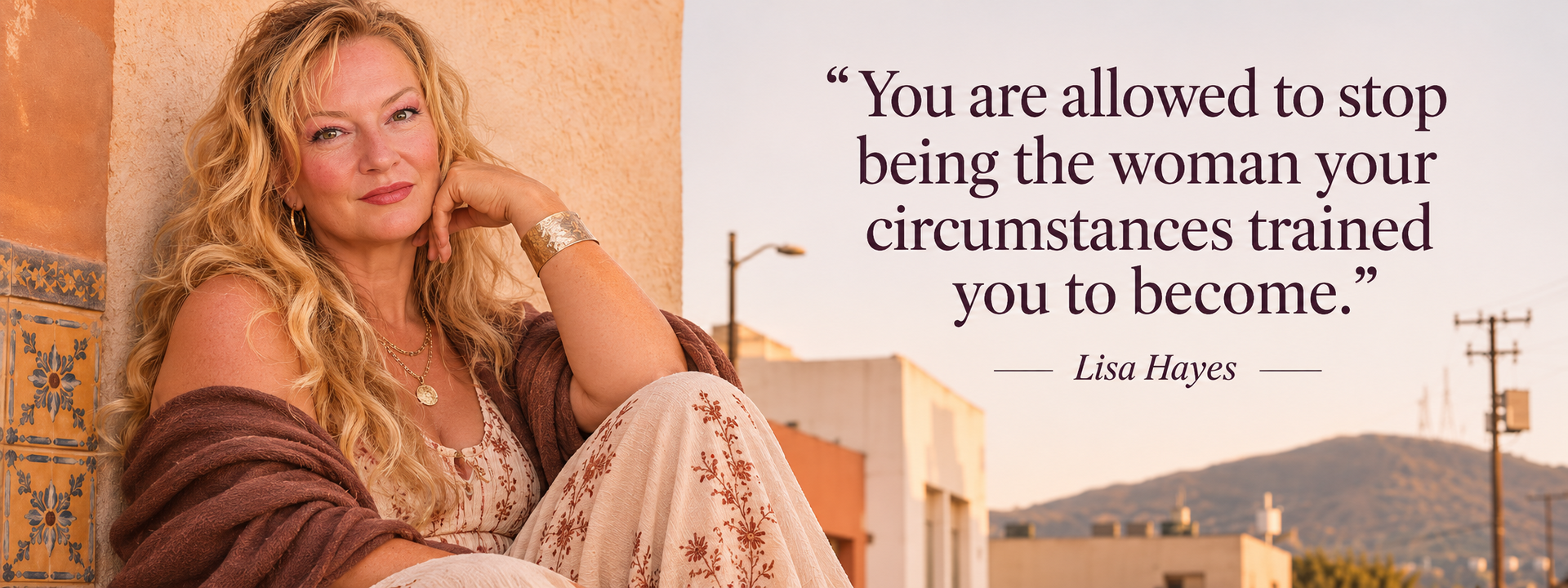
You are allowed to stop being the woman your circumstances trained you to become.
Lisa Hayes
Grown Woman Magic | Identity Engineering | A Life with More Freedom, Beauty, and Room to Breathe