Lost and Seeking: How Erased Spiritual Roots Lead White Women to Appropriation
Did you know God Had a Wife?
White women, we are lost. We find ourselves clinging to spiritual practices that are not ours, trying to find meaning in spaces that only deepen the disconnection inside. We're searching to find something, anything, to fill the space that's been hollowed out over centuries of spiritual erasure.
In truth, this hollowing out began long before we were even born. They were carved by the hands of those who sought to erase our spiritual ancestral practices, to strip us of the divine feminine that once guided us, and to bind us to a patriarchal narrative that never served us.
We are lost because our spiritual roots were severed. We've been wandering ever since AND in order to move back towards wholeness, we need to acknowledge because of our disconnection, we have done a lot of harm.
Everything we believe about the spiritual heritage of pre-Christian Europe is a fiction, carefully crafted to destroy the living remnants of our culture. Our richly endowed polytheistic traditions and divine-feminine-based spiritual practices were systematically dismantled, buried, and replaced by a patriarchal narrative that served the interests of men and early Christianity.
A spiritual lineage that once flowered across Europe had been all but obliterated—and the remains of it were now nothing more than fragments and echoes of a past deliberately forgotten.
One of the most amazing examples of this erasure is the story of Ashara, the wife of Yahweh. During the first days of spiritual practice, she was taken to be an equal, if not more beloved counterpart to the God in the Old Testament. She was a strong feminine presence, highly worshipped and deeply integrated into the spiritual life of people. When Christianity began to spread, the worship of Ashara became a threat to the new patriarchal order.
Christianity, upon its ascendancy, not only effaced Ashara—it demonized her. Once a goddess of great significance, she was re-imagined as a creature of reproach, reverently referred to as a whore, her authority stripped, and her history degraded. This wasn't merely an instance of religious supremacy but a strategic move on the part of Christianity as it allied itself with patriarchy. Together, they set out to exorcise the divine feminine from spirituality and build a patriarchal order that would keep women in subjugation for ages to come - and it has worked.
It was through this systemic erasure of feminine deities such as Ashara and the creation of a monotheistic and man-centered narrative that Christianity became the greatest tool of patriarchy in history. The collaboration with patriarchy has long been used to bind and silence women, leaving a chasm in our spiritual existence—a chasm that white women today still feel but often cannot locate the source of.
Today we find ourselves lost in a spiritual sea, striving after something that will feel real and mean something. We long for something to deeply resonate within our souls, something which Christianity, in its patriarchal form, has failed to deliver. And, as a result, we many times stumble into the area of appropriation—taking from other cultures the spiritual practices and beliefs that we no longer recognize as ours.
But this act of appropriation is not just a harmless quest for meaning: it is a continuation of the very same cycles of erasure and exploitation that robbed us of our own spiritual heritage. It's not borrowing. It's theft. We are grasping what is not ours, all too often without understanding the sacred significance and depth of that which we grasp for. This perpetuates a history of colonization, wherein one culture's loss becomes another's gain, continuing the very patterns of oppression we seek to escape.
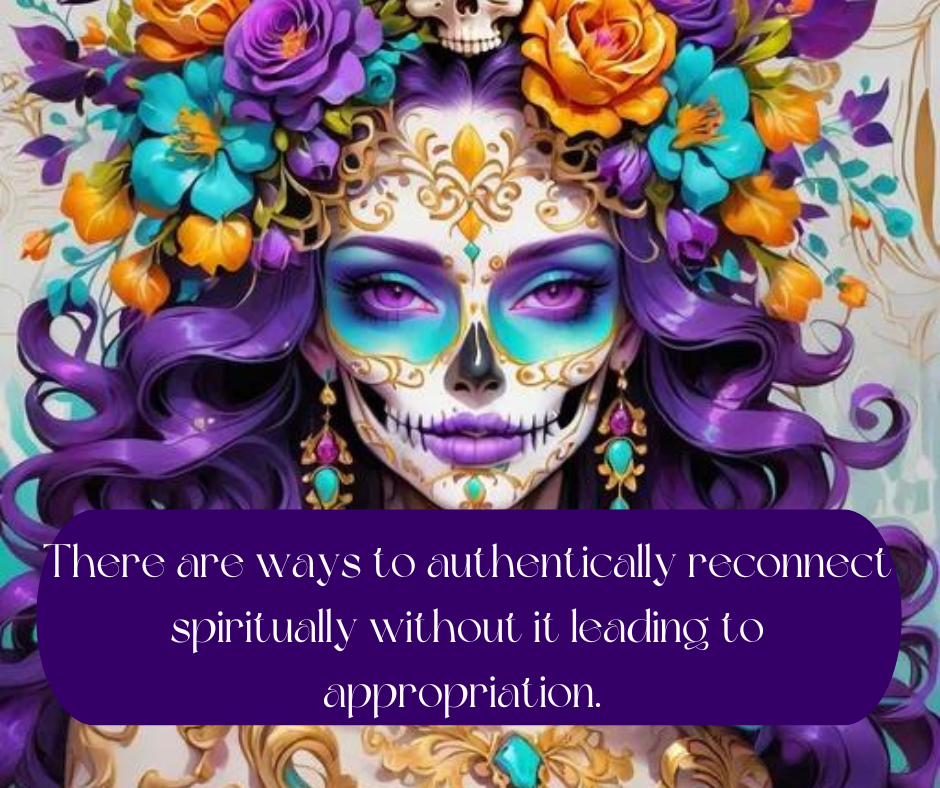
Yet it doesn't have to be this way. There are ways to authentically reconnect spiritually without it leading to appropriation. First, let's acknowledge the truth: our spiritual traditions were taken from us, quite literally erased by people who were afraid of the power of the divine feminine. Reclaim what was lost through an in-depth analysis of the past, research, and revivification of stolen spiritual practices.
It's not replicating these traditions in whole; not everything that has been broken can be entirely restored. But inspiration can be taken from what has remained.
We are free to show the divine feminine, which was so brutally made silent; we can investigate the polytheistic traditions that once celebrated the many faces of the divine and reconstruct a spirituality reflecting our values and the lives we lead today. It is an act of rebellion, a reclamation of what was stolen from us, a new forging of a spiritual path deeply rooted in our histories and traditions.
By doing so, we can stop reaching for what is not ours and start building that which reveres the past and calls forth a future in which feminine divinity will no longer be quiet. It becomes incumbent upon us to return to the spiritual strength of which we have been deprived and build a practice that is true, respectful, and resonant to us.
We heal this way. It's the way we cut that vicious cycle of appropriation and set off on a course of real spiritual reclamation: facing our past, facing what has been obscured from our spiritual roots, and setting forth to rebuild the foundation—creating a spirituality that honors the divine feminine, is sacred, and binds us back into the depth and power that was once ours.