The Beautiful Art of Deoptimization
On the radical pleasure of becoming
a little less efficient and a great deal more alive
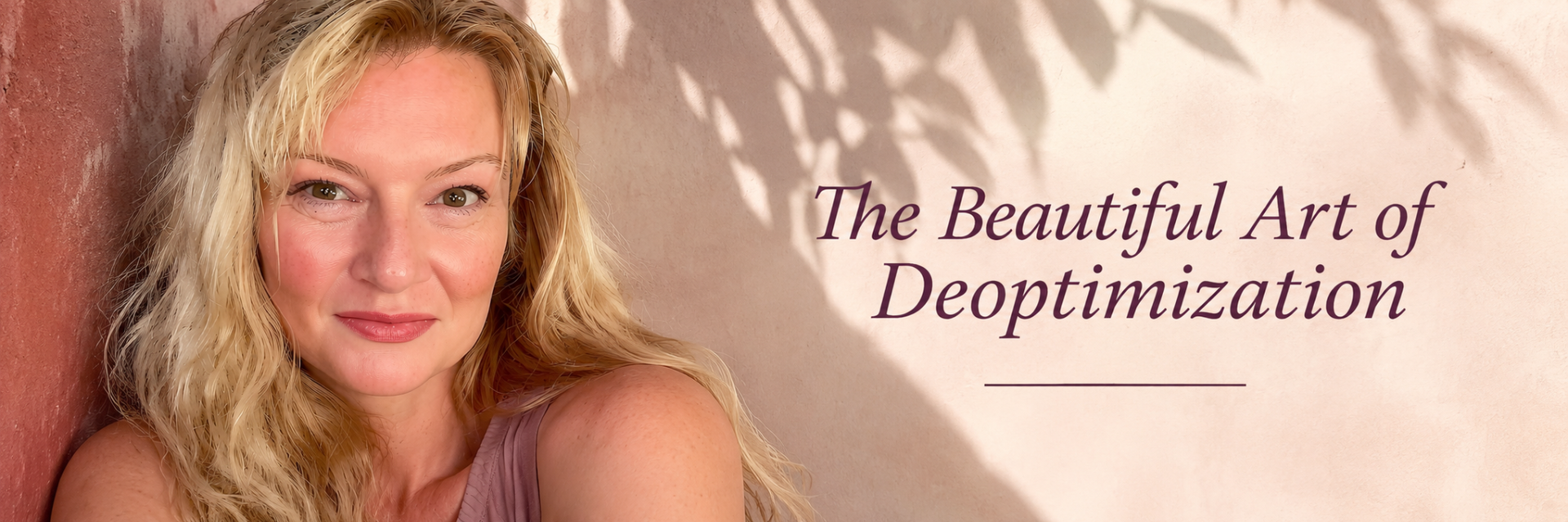
The Beautiful Art of Deoptimization
On the radical pleasure of becoming a little less efficient and a great deal more alive
I have spent enough of my life being a competent woman to know that competence can become a rather elaborate trap.
There is always something that could be improved. A better morning routine. A more efficient way to organize the kitchen. A supplement worth investigating. A system for managing the systems. A clever little application that promises to give me back seventeen minutes a day, provided I spend three hours learning how to use it.
And, of course, there is the woman I might become if I could just get all of it right.
She is well rested, beautifully dressed, physically strong, emotionally regulated, financially secure, spiritually evolved, politically informed, and somehow always remembers to defrost something for dinner.
I have been acquainted with various versions of this woman for decades.
She seems terribly busy.
The modern obsession with optimization has managed to turn almost every aspect of human existence into a performance improvement project. We track our sleep, our heart rates, our steps, our moods, our productivity, our hydration, and occasionally our bowel movements. We measure the quality of our leisure. We turn friendships into networking opportunities, hobbies into side businesses, and spiritual practices into techniques for improving our nervous systems.
Even pleasure gets assigned a job.
A walk is supposed to improve cardiovascular health. Meditation should increase focus. Reading is valuable because it makes us smarter. Rest is justified because it makes us more productive tomorrow.
Apparently, we can no longer sit in a garden and enjoy the flowers without demonstrating that the experience contributes to our long-term well-being.
I find this exhausting.
I also think the entire arrangement is ridiculous.
Somewhere along the way, we accepted the peculiar idea that a good life is one in which every resource is being used efficiently. Every hour should accomplish something. Every habit should produce a measurable benefit. Every personal characteristic that causes friction should be examined, corrected, or transformed.
We have become both the factory and the factory manager.
Women, in particular, are remarkably vulnerable to this arrangement because we have been trained to regard self-improvement as a moral obligation.
We are supposed to be attractive, but effortlessly so. Successful, but approachable. Healthy, but not vain. Accomplished, but available. Sexually desirable, but respectable. Nurturing, but independent. Politically conscious, environmentally responsible, emotionally intelligent, and perpetually willing to examine our own shortcomings.
The standards change. The work never ends.
Now an entire industry stands ready to help us manage the impossible assignment.
There is money to be made convincing a woman that her ordinary human existence requires constant intervention.
I say this as a woman who has spent much of her professional life helping other women change their lives.
I believe in change. I believe in learning, healing, growing stronger, becoming more skillful, and deliberately shaping an identity. I enjoy a good system. I have tracking devices. I lift weights. I make plans. I appreciate the extraordinary things that become possible when a woman decides to participate consciously in her own becoming.
But the pursuit of a better life can consume the very life it was supposed to improve.
You can become extraordinarily good at managing yourself and still have very little room to enjoy being yourself.
The Art of Deoptimization
This is where deoptimization comes in.
Deoptimization is the deliberate decision to stop demanding that every part of your life justify its existence through usefulness, efficiency, or improvement.
It is allowing some experiences to be gloriously unproductive.
It is buying flowers because you like flowers, without requiring them to serve as a mindfulness practice.
It is wearing the beautiful dress on an ordinary afternoon.
It is reading a novel that teaches you absolutely nothing useful.
It is making a complicated dinner because the kitchen smells wonderful and you enjoy the ceremony of cooking.
It is having a conversation that wanders for two hours and resolves precisely nothing.
It is keeping a slightly ridiculous object because it makes you happy.
In my garden, there is a little angel who has been through a fire. She has lost some paint, acquired a few stains, and now lives among succulents that have no apparent intention of behaving themselves.
I could restore her.
I could tidy the plants.
I could turn the whole corner into something more polished and deliberate.
But I like her exactly where she is.
She has a history. The garden has a personality. Neither needs my management.
I think this is a useful way to approach a life.
We spend so much time imagining the future version of ourselves who will finally have everything in order that we risk becoming inattentive to the woman who is already here.
She has preferences. She has appetites. She has strange little affections and unreasonable pleasures. She has a body that might enjoy a long bath more than another fitness challenge. She has ideas that don't need monetizing and talents that don't need developing into expertise.
She may even have an afternoon in which absolutely nothing needs to happen.
Imagine that.
The Politics of Productivity
There is a political dimension to all of this, too.
A culture that measures human worth through productivity is remarkably comfortable with exhausted people. When every problem is presented as an individual failure of discipline, organization, resilience, or mindset, we are less likely to examine the systems making ordinary life so difficult.
If a woman is drowning in unpaid care work, inadequate healthcare, economic insecurity, and impossible social expectations, the answer cannot always be another morning routine.
Sometimes the problem is the arrangement itself.
Deoptimization asks us to reconsider who benefits from our relentless self-management.
It also asks who gets permission to live inefficiently.
Leisure, beauty, spaciousness, and pleasure have always been distributed unequally. Some people inherit the freedom to waste an afternoon. Others are expected to account for every minute of their existence.
So when I talk about making a life more beautiful, I am not suggesting that everyone simply purchase more lovely things or rearrange their calendars. I am talking about freedom, including the collective conditions that make freedom possible.
A woman should not have to earn the right to enjoy being alive.
Neither should anybody else.
A Different Understanding of Success
Deoptimization also requires a different understanding of success.
A successful day might contain an important accomplishment. It might also contain a leisurely breakfast, a conversation with someone you love, a swim, a good book, or an hour spent admiring the way the afternoon light moves across the wall.
A successful life might be ambitious, extravagant, influential, and full of remarkable achievements.
It might also have some gloriously inefficient corners.
There is room for both.
I still want things. Quite a lot of things, actually. I have ambitions, work I care about, ideas I intend to bring into the world, and a very definite appreciation for money, beauty, influence, and pleasure.
I have no intention of becoming less capable.
I simply refuse to make capability the organizing principle of my entire existence.
I want a life with room for mystery. For eccentricity. For friendships that accomplish nothing beyond the pleasure of one another's company. For gardens that grow wild and afternoons that escape the calendar.
For the possibility that some of the finest experiences of being human cannot be measured, improved, or made more efficient.
Perhaps that is the beautiful art of deoptimization.
You look at your life, with all its systems and ambitions and carefully considered plans, and begin making room for things that exist for no reason beyond the fact that you love them.
You stop asking every pleasure to prove its worth.
You let some things remain delightfully unnecessary.
And you discover just how much life fits into the space you stop trying to optimize.
Your life is not a problem that needs solving.
It is a life that deserves to be lived.