The How and Why of AI - Disclosure Statement
AI usage comes at a cost and like all powerful tools should be used responsibly.
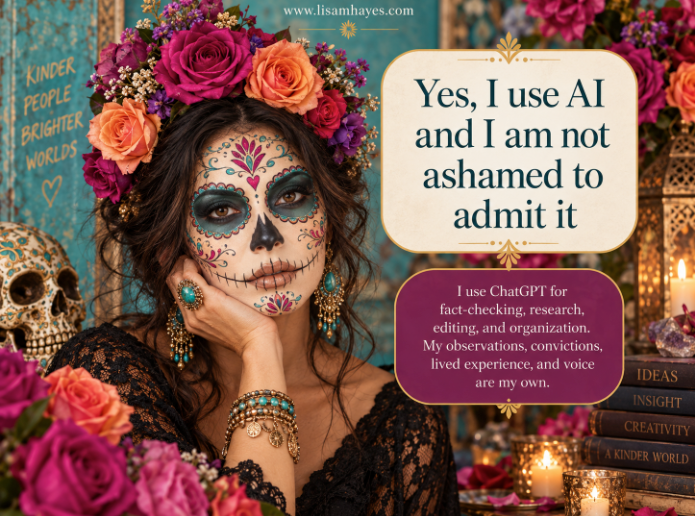
You’ll start seeing an AI disclosure statement on some of my writing. I want to tell you why, and a little about what actually happens between the thoughts in my head and the thing you read.
My head is frequently a very messy place, and the journey from head to page is never a straight line.
Two things are true in my relationship with AI: I work very hard to preserve my own voice, and ChatGPT knows that voice better than any editing partner I’ve ever worked with.
That is a strange sentence to write after decades of being a writer. It is also an honest one.
My head is a whirlwind of too many streams of thought almost all the time. I’ll start with families gathering on a holiday weekend and find myself thinking about my grandmother in Colorado, the Berlin Wall, and the particular cruelty of deciding whose grief deserves our attention. Those things belong together in my mind. Getting them onto a page in an order another person can follow can be exhausting.
AI takes a tremendous amount of that work off my hands. I can bring the whole unruly thing into the conversation before I’ve figured out where it begins.
Sometimes I bring a nearly finished piece. Sometimes I bring paragraphs of thought with no discernible respect for sequence. Sometimes ChatGPT produces the first full draft from what I’ve shared, and we work from there. Calling all of that “editing” would understate the contribution.
But there is also a lot of me saying: I would never say that. That’s too tidy. You took the anger out. That sentence sounds like it belongs in a brochure. Please stop using that phrase forever.
I am particular, but it is not a perfect process. Writing never is. Sometimes my work, organically, reads like what looks like AI when it’s not. I have always written long posts - the one you’re reading being a good example. I have always written in one-sentence lists for emphasis. I had ALWAYS used the “ - “. I didn’t know what an em dash was until people started talking about AI slop. I resent that I have felt compelled, at times, to moderate my natural writing style, so as not to appear to be doing something I wasn’t.
Over time, this working relationship with AI has made room for the ways I want to write, including the ways that don’t conform to traditional writing advice. Sometimes I want the repetition. Sometimes the sentence needs to run longer than it should because I want you to feel how long I’ve been holding my breath. Sometimes correct grammar would make the thing less mine.
I want help making myself understood while keeping the peculiarities that make it sound like me. And often, that is exactly what I get.
There is friction, too. Occasionally the editorial feedback asks for more restraint than I want. More often, it asks for the kind of restraint I should have: be precise about what you know. Check the history. Don’t let a compelling suspicion become a statement of fact simply because you are angry enough to believe it.
I don’t always enjoy that part. I didn’t enjoy it working with human editors either, and over time, I have worked with many human editors, some of whom did not do a good job for me, and sometimes that made those relationships very expensive.
Even though I don’t enjoy someone pulling back a little on the reins, I value it. Anyone who knows me well knows sometimes I need to pulled in on a shorter leash because my words can get ahead of good sense, what’s appropriate, or what’s true when I’m feeling passionate (read: angry).
I still have to decide whether a correction is warranted, whether the evidence supports a sentence, whether the language has gone soft where it should have stayed sharp. I am responsible for what I publish. A disclosure statement doesn’t transfer that responsibility anywhere else.
It does let you know how the work was made.
I have been thinking about that responsibility, too. Readers deserve an accurate account of a process that has become a meaningful part of my writing life. I want to acknowledge the help in proportion to the help I actually received.
I also want to be clear: I am not inviting a moral referendum on my use of AI. I will not be debating whether accepting this help makes me less of a writer, less intelligent, or less entitled to my own voice. I resent the shaming and the ease with which people turn someone else’s working process into an opportunity to feel superior.
AI has been part of many of our lives for years, often tucked into systems we barely notice. Its more visible arrival deserves serious thought. I don’t think the high horses are helping.
There are consequential questions about how this technology is built, who controls it, whose work supports it, and who benefits. I care about those questions. Judging an individual for using help to make their thoughts intelligible does very little to answer them.
And I believe AI has enormous potential to be a societal equalizer. We live in a world where access to information, and the ability to intelligently synthesize and use it, is capital. People with money have long been able to hire researchers, editors, tutors, and strategists. They can pay other people to help them understand things and make themselves understood.
More people having access to some of that help matters to me. A person can have something valuable to say and struggle to organize it. They can be capable of learning something complicated without being able to afford someone to explain it.
The distance between having an idea and being able to do something with it can consume years of a life.
AI can help shorten that distance. How widely those benefits are shared will depend on the choices we make. I want more people to have that opportunity, and I am comfortable being one of them.
I may lose readers over this. I hope some will stay curious. I can’t make that decision for anyone, and I don’t want to manage it by leaving something out.
The experiences are mine. The convictions are mine. So are the strange associations, the tenderness, the occasional questionable punctuation, the anger and the love.
There is real assistance involved in getting those things onto the page. Going forward, I’ll be naming it.
-This piece was drafted in collaboration with ChatGPT from my own reflections and experiences. ChatGPT helped shape, organize, and edit the language.